 LoveDesignBuildRepeat
Renovation of historical urban villa in Ibiza
Location: Ibiza, Spain . GFA: 450 sqm
Architectural concept
Dalt Vila UNESCO World Heritage Site
Nestled within the ancient limestone ramparts of Dalt Vila UNESCO World Heritage Site, this duplex villa renovation presented our studio with one of the most resonant commissions we have undertaken - a rare opportunity to breathe contemporary life into a structure whose walls carry nearly three millennia of layered civilisation. The client, a discerning individual of international sensibility and deep respect for Mediterranean culture, wished to transform a historically significant urban dwelling into a singular private residence - one where the silence of thick stone walls and the spectacle of terracotta rooftops become the primary luxury. We proposed an architectural language that neither mimics the past nor ignores it, but enters into an honest, elegant dialogue with it.
Spatial organisation
The 450 sqm programme unfolds across two residential levels above a generous ground-floor volume accommodating garage and cellar storage - a spatial logic that mirrors the traditional urban typology of Dalt Vila itself. Living spaces are oriented toward the south and west to capture the extraordinary panoramas across the old town, the marina, and the encircling hills. The rooftop terrace, visible in our project imagery, takes on the character of a true outdoor salon - furnished with a sculptural woven chaise longue, a suspended bowl fireplace for cooler evenings, and a generous L-shaped lounge set arranged around a chess-topped coffee table, inviting the kind of unhurried afternoon that only this island seems to permit. Every spatial decision was guided by one principle: the view is architecture too.
Materials and climate
vernacular Mediterranean construction
Our studio selected a palette rooted entirely in regional craft and vernacular Mediterranean construction. Load-bearing walls of mares sandstone - the honey-coloured oolitic limestone quarried on the Balearic Islands for centuries - were retained and consolidated, their thermal mass performing the passive cooling work that no mechanical system can replicate with the same grace. Interior surfaces received hand-applied cal lime plaster, its matte luminosity softening afternoon light into something almost liquid. Ceiling structures reference the traditional method of sabina juniper beam construction, the resinous local timber lending warmth and scent to upper-level rooms. Blue-painted timber shutters, seen in the facade photography, are not decorative affectation but a precise solar shading solution - adjustable, operable, and deeply rooted in the island's building memory.
Style
A Heritage Restoration inside Dalt Vila's UNESCO-listed walls, where the constraints are the design. The old town's stone, lime, and timber are preserved and revealed, the palette kept muted and patina-rich so the historic fabric carries the room. Modern insertions — services, joinery, the minimal interventions a contemporary life requires — are drawn cleanly and left clearly new against the medieval shell. The rule is uncompromising: nothing original is destroyed, and nothing added pretends to be older than it is. The result is Ibiza's past and present sharing the same wall.
Bioclimatic strategy
narrow-aperture fenestration
Ibiza belongs to the Csa Mediterranean climate zone, where summers regularly reach 32 to 36 degrees Celsius and outdoor comfort extends across eight months of the year, from April through November. Our passive cooling strategy is built around three interdependent principles. First, the thermal mass of walls measuring 60 to 80 centimetres absorbs daytime heat and re-radiates it outward through the cool night, stabilising interior temperatures without mechanical intervention. Second, deep-set windows and the traditional narrow-aperture fenestration of Dalt Vila limit direct solar gain while preserving visual connection to the landscape. Third, the plan section is organised to promote cross-ventilation between the cooler north-facing stairwell and the south-facing terrace, drawing fresh air through the dwelling during the long, luminous evenings.
Energy and sustainability
In alignment with the island's near-zero energy building standard for residential renovations, our studio integrated an aerothermal heat pump system for heating, cooling, and domestic hot water - sized precisely for the 450 sqm load profile and discreetly housed within the ground-floor service volume. A rooftop photovoltaic array, positioned to respect the heritage silhouette as viewed from the citadel, supplies the majority of annual electrical demand. Roof surfaces are treated with a reflective lime-wash membrane coating to reduce urban heat island effect. Rainwater harvesting feeds both landscape irrigation and toilet flushing - a critical consideration on an island whose freshwater resources are finite and precious. Insulation incorporates posidonia oceanica fibre panels, a zero-kilometre material harvested from Balearic seagrass meadows and certified for heritage applications.
Landscape
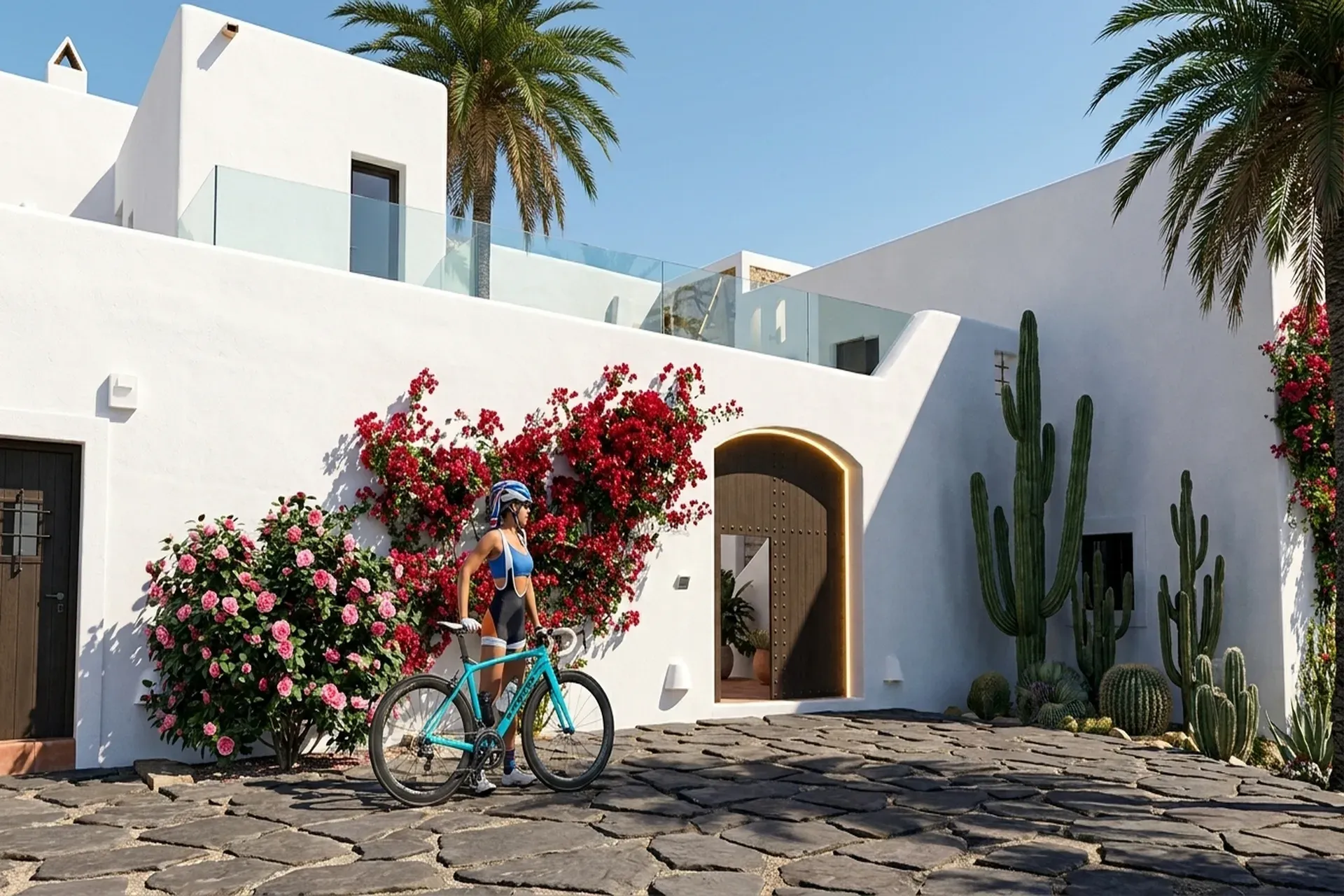
The rooftop terrace and lower planted volumes are designed as a drought-tolerant garden requiring no irrigation beyond the harvested rainwater supply. Our planting palette draws exclusively from the island's indigenous and historic agricultural species - carob, fig, almond, and olive for canopy and shade, underplanted with rosemary and lavender whose fragrance rises into the living spaces on warm evenings. The bougainvillea climbing the western parapet wall, its magenta flowers brilliant against the white lime render, is both ornamental and functional - providing seasonal solar shading to the terrace edge. Stone planters constructed from reclaimed mares blocks anchor the composition and complete the material continuity between architecture and garden.
In the end, true luxury in a place as ancient as Dalt Vila is expressed not in excess, but in the depth of silence that only well-proportioned stone walls can provide.
Interested in a similar project?
Let's discuss your vision and create something extraordinary together.
Get in touch